Data is information. This can be just the number ‘3’ or a whole book.
Computer Programming Languages manipulate (use or change) data.
We generally split data into two categories in Scratch: numbers and strings. Strings are either single characters, words or sentences.
 Examples of numbers: 1, 1.0, 15, 18, -5
Examples of strings: “A”, “b”, “I like Pi”, “$400”, “(^_^)”, “Sentences etc.”
This is a variable in Scratch. Variables contain Data.

Putting Data into a Variable


Showing/Hiding Variables

Event Handler: The “When Green Flag is Clicked Block” is an event handler. This means that it executes code in response to a stimulus.

Operators: These green blocks allow you to simply manipulate data. We will first focus on number operators.


Other “Number” Operators:
We can also generate randomness and with integers b/t intervals. Scratch also has a built in “round” command.


Variables + Operators: As you may have guessed, we can place variables inside of our operators. In order for the operators to work correctly, the variable needs to be holding a number.
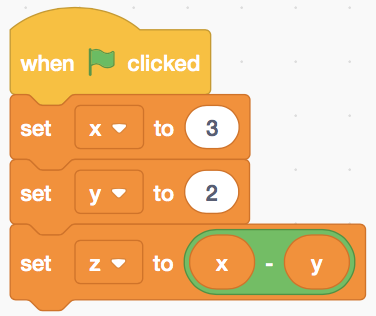
Find the final value of z in the following code:
Printing: This is a convenient way to examine the final data (output) of our project. This will “print” by having the sprite say the data on stage.

Problems:
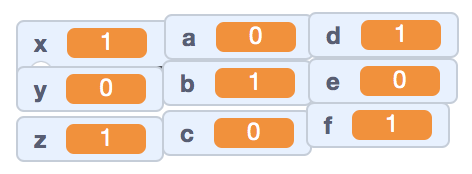
Create a 3x3 table of variables on stage (nine variables total). Set each of these variables to create a X in your table. Note: You can move variables around the screen with your mouse.
Find the rounded answer for 6012.345*1232.1234 = (Write it here)
Advanced Assignment: Code a program which generates random math problems on screen with division (see the image below for an example output).

Appendix 1: Advanced “Numbers” Operators
Scratch has many built-in operators that perform more advanced mathematical functions. These include the trigonometric functions (sin, cos, tan).

Scratch also contains the modulo operator which finds the remainders. Essentially, this looks at the “left-over” piece from division. For example, if I divide 4/3, it would equal 1 + 1/3. The modulo function would then return 1 because this is the piece which did not divide in evenly.

This article provides a beginner-friendly introduction to data processing concepts in Scratch by explaining variables, numbers, strings, operators, and event handling in a simple and practical manner. The combination of examples and hands-on exercises helps learners understand how data is stored, manipulated, and displayed, making it an excellent foundation for developing logical thinking and programming skills.
ReplyDeleteUnderstanding variables, mathematical operators, and data manipulation is fundamental to creating interactive Scratch projects and learning core programming concepts. Students seeking similar educational programming ideas can explore Project Ideas for CSE Students, where software development and problem-solving techniques are applied across a variety of applications.
The inclusion of random number generation, modulo operations, and mathematical functions encourages learners to build more dynamic and engaging projects while strengthening computational thinking. Exploring Domains in Computer Engineering can provide additional inspiration for educational software, game development, and interactive programming projects.
ReplyDeleteFor readers interested in discovering a broader range of computer science project ideas and emerging technology domains, Domains in Computer Engineering offers valuable insights into various specializations and practical project opportunities for students.
ReplyDeleteThis article introduces the fundamentals of data processing in Scratch by explaining how variables, numbers, strings, and operators work together to manipulate information. The simple examples and practical exercises make it easy for beginners to understand core programming concepts while developing logical thinking and problem-solving skills.
ReplyDeleteAs learners progress, understanding how data is organized, processed, and presented becomes increasingly important. Strengthening these concepts through Data Analysis Course and Data Visualization Training can help bridge the gap between basic programming and real-world data-driven applications.
ReplyDeleteAs learners progress, understanding how data is organized, processed, and interpreted becomes increasingly important. Strengthening these concepts through Data Analysis Course helps learners build practical skills in organizing datasets, performing analysis, and drawing meaningful insights from information.
ReplyDelete